

The Best Way to Position Yourself in the AI Era

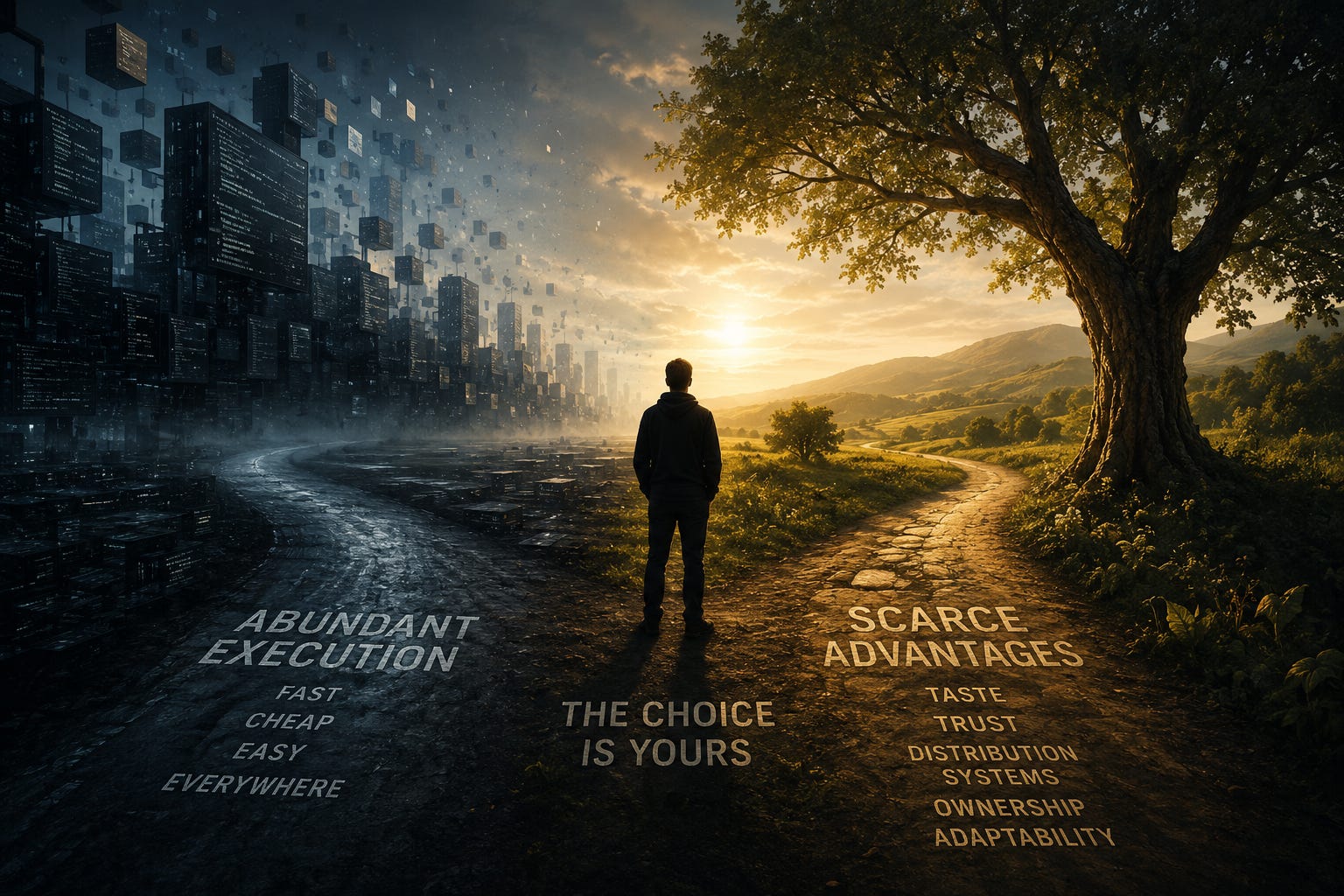
There is a particular kind of silence that arrives right before the world changes. Not the silence of nothing happening, but the silence of almost everyone watching the wrong thing.
Right now, most people are watching the tools. The chat windows. The image generators. The demos that go viral on a Tuesday and feel ancient by Friday. They are watching the smoke, and the smoke is genuinely spectacular. But the smoke is not the story.
The story is underneath. An entire civilization is reorganizing itself around intelligence, the way the last one reorganized around electricity and the one before that around steam. When a shift like that happens, the people who win are almost never the ones who learned to operate the new machine fastest. They are the ones who understood what the machine did to the value of everything else.
That is the real question of this decade. Not how to use AI. That answers itself in a weekend. The real question is stranger and far more important. When intelligence becomes cheap and abundant, what becomes scarce and precious? Because wherever the answer points, that is where you want to be standing.
This essay is about where to stand.
Execution Used to Be the Moat. Now It Is the Water.
For most of human history, the bottleneck was doing. Ideas were everywhere. Execution was rare. You could have a brilliant concept for a film, a company, a song, a piece of software, and it meant almost nothing, because the distance between the idea and the finished thing was enormous. It took teams, time, capital, and skill that took years to acquire.
That distance was the moat. It was where careers were built and fortunes were defended. “I can actually make this” was a rare and valuable sentence.
AI collapses the distance. The first draft, the prototype, the rough cut, the working model, the analysis, the campaign: all of it is moving from weeks of skilled labor to an afternoon of skilled direction. The cost of production is falling through the floor, and it is not coming back up.
Here is the part most people miss. When execution becomes abundant, it stops being valuable. Water is essential for life and costs almost nothing, precisely because it is everywhere. Execution is becoming water. The thing that surrounds you, not the thing that sets you apart.
I have watched work that once took a small team a week collapse into an afternoon of one person directing a machine. The speed was not the surprising part. The surprising part was how quickly the people watching stopped being impressed. A miracle becomes a default in about a quarter now. That is the tell. That is what abundance does to a thing.
AI did not lower the value of work. It moved it.
There is an older word for what is happening, and it is worth borrowing. Inflation.
When a country prints money faster than it makes anything real, every bill in your pocket buys less. Not because you did anything wrong. Because the thing you are holding stopped being scarce. We are living through the first great inflation of intelligence. The machines are printing thought at a rate the world has never seen, and the same quiet, brutal logic applies. The output in your hands is worth less every month, not because your work got worse, but because the world got flooded with work just like it.
And every inflation in history moves wealth in exactly one direction. Away from whoever holds the thing being printed, toward whoever holds the things that cannot be printed. The cash loses. The land, the art, the trust, the rare and the real: all of it climbs.
So the rest of this essay is one question, asked again and again in different rooms. In the inflation of intelligence, what are the things that cannot be printed? Find them. Stand on them. That is the whole game.
When Making Is Free, Knowing What to Make Becomes Everything
The first thing that cannot be printed is taste.
Taste is a word people underrate because it sounds soft. It is not soft. It is the compressed residue of ten thousand small judgments about what is good, what is true, what is worth attention, and what is noise wearing the costume of signal. It is the ability to look at a hundred possible directions and feel, before you can explain why, which one is alive.
In the old world, taste sat on top of skill. You needed the skill first. In the new world the skill is nearly free, so taste is no longer the topping. It is the entire dish.
Picture two people with the same models, the same access, the same afternoon. One produces a flood of competent, forgettable, slightly-wrong-in-spirit work. The other produces a small body of work that makes a stranger stop scrolling and feel something. The machine was identical. The difference was the human holding it, and the years that human spent paying attention to the world until a point of view formed.
When everyone can make anything, the only scarce thing left is knowing what is worth making.
So the first move is almost heretical in an age obsessed with tooling. Forget the tools for a moment and build the taste. Read widely. Look closely. Form opinions, defend them, revise them. Sharpen the part of you that knows the difference between fine and unforgettable. The machine will handle the making. You handle the knowing. In the years ahead that may be the most valuable job there is.
Trust Becomes the Rarest Asset on the Internet
The second thing that cannot be printed is trust. And it is about to become the rarest asset on the internet.
Here is the uncomfortable arithmetic. When anything can be made, anything can be faked. The default assumption about any piece of content is sliding toward suspicion: that a machine could have made it, that the face might not be a person, that the review is synthetic, that the article is a confident hallucination. This is not a doomsday forecast. It is supply and demand. Infinite synthetic everything is colliding with a finite human capacity to verify.
You already know the feeling. You pause on a face, a voice, a clip, and underneath the watching there is a small new question that did not used to be there. Is any of this real. A year ago that flicker was rare. Now it is the water the whole internet swims in.
In that world, trust stops being a nice-to-have and becomes the scarcest resource in the system. Not attention. Trust. Attention is cheap and getting cheaper. Trust is expensive and getting more so, because it cannot be generated on a server. It can only be earned, slowly, by being right when it would have been easier to be loud, and honest when no one would have caught the lie.
In a world drowning in the synthetic, the realest thing you own is the trust of the people who chose to believe you.
This is why a human reputation is about to matter more than at any point in modern life. The faceless brand and the anonymous account get cheaper to imitate every month. But a specific person with a track record, a voice, and a history of telling the truth even when it cost them is almost impossible to counterfeit. The years it took to build are exactly what make it valuable. You cannot print a decade.
So be a source of truth in your corner of the world. Not the loudest. The most reliable. In an ocean of noise, the trusted do not have to chase attention. Attention comes and finds them.
Distribution Is the New Production
For a long time the hard part was making the thing. Distribution was an afterthought you figured out later, or paid a gatekeeper to handle.
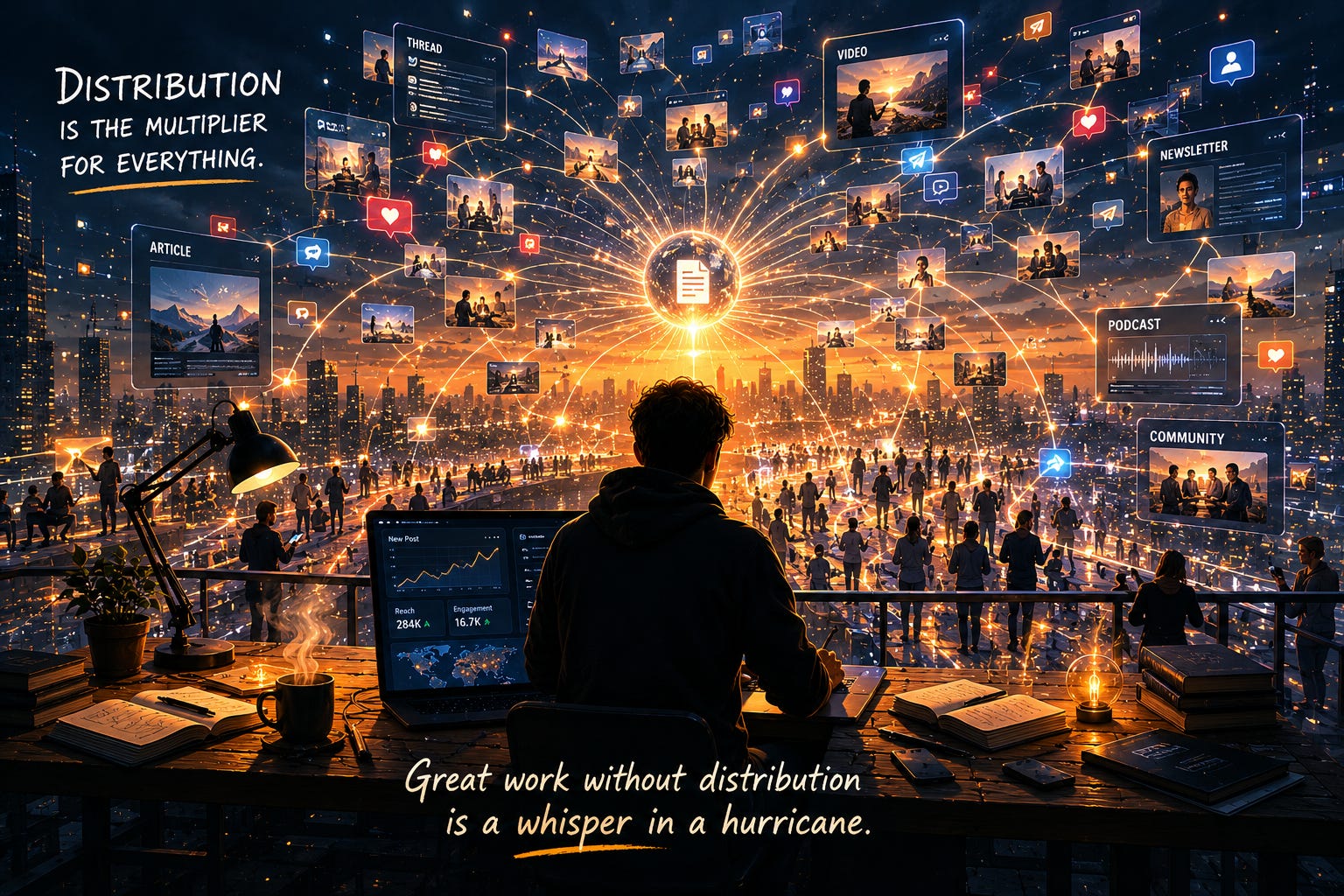
That has flipped. Making is the easy part now. Getting the thing in front of the right people, and having those people actually care, is the rare and valuable part. So the relationship with the people who chose to listen to you becomes worth more than any single thing you could make for them. That relationship is the one asset the flood cannot replicate.
I keep noticing that the recommendations that actually change what I do no longer come from the largest accounts. They come from the handful of people whose judgment I have watched hold up over years. Eight hundred people who trust you can move more than eight hundred thousand who half-recognize your name. And the migration is already underway. Watch where attention is quietly going. Into smaller rooms. Group chats, paid communities, the dinner instead of the conference. People are not leaving the internet. They are retreating from the parts that feel manufactured, toward the parts that still feel like other people.
This is the real reason owning your audience matters. Not renting it from an algorithm that can change its mind overnight, but owning the direct line: the list, the community, the people who would follow you to a new platform if the old one vanished tomorrow. That line is becoming one of the most durable forms of wealth a person can build, and almost no one treats it that way yet.
Anyone can make the thing now. The leverage is in being the person people already trust to receive it.
If you are a creator, an operator, a founder, this is the part to internalize first. Building and keeping an audience is not marketing anymore. It is infrastructure. It is the ground everything else stands on.
Communication Becomes a Superpower
When ideas are cheap and execution is nearly free, the ability to move people becomes the multiplier on everything else.
We are about to be buried in output. Most of it will be technically fine and emotionally dead, saying something without making anyone feel anything. In that environment, the person who can take a complex idea and make it land, make it clear, make it stick, make someone change their mind, holds a power that compounds across every room they enter.
Clear communication has always mattered. What is new is the reach. A single well-made idea can travel to millions at no cost, amplified and translated and repurposed by machines that handle the mechanics perfectly but cannot manufacture the original spark of meaning. The spark is still human. The amplification is now infinite.
Clear thinking is the rarest commodity. Clear communication is just clear thinking made contagious.
So learn to write. Learn to speak. Learn to find the one sentence that carries the whole idea. The machines will scale your words further than any generation has ever been able to reach. Make sure the words are worth scaling.
Stop Thinking in Jobs. Start Thinking in Systems.
Here is the mindset shift that quietly separates the people who thrive from the people who merely survive.
A job is a thing you do. A system is a thing that does work for you. For the entire industrial era almost everyone was trained for the first one. Get the credential, get the role, perform the task, trade hours for money, hope the task survives. That made sense when human hours were the only way to get anything done.
But a job is a single point of failure. It depends on you showing up, and it stops the moment you do.
A job is a single point of failure. A system is a compounding asset.
The AI era rewards systems with a force we have never seen, because for the first time the systems can hold intelligence inside them. Not code repeating one step forever, but processes that reason, write, analyze, adapt, and respond. You can wire tools and agents and content engines into something that does the work of a small team and keeps running while you sleep.
So stop asking which job is safe from AI. It is a defensive question and it leads somewhere small. Ask instead what system you can build that puts AI to work at scale. That question leads somewhere expansive. It takes the thing everyone fears and turns it into the engine you are driving.
One Person Can Now Operate at the Scale of a Company
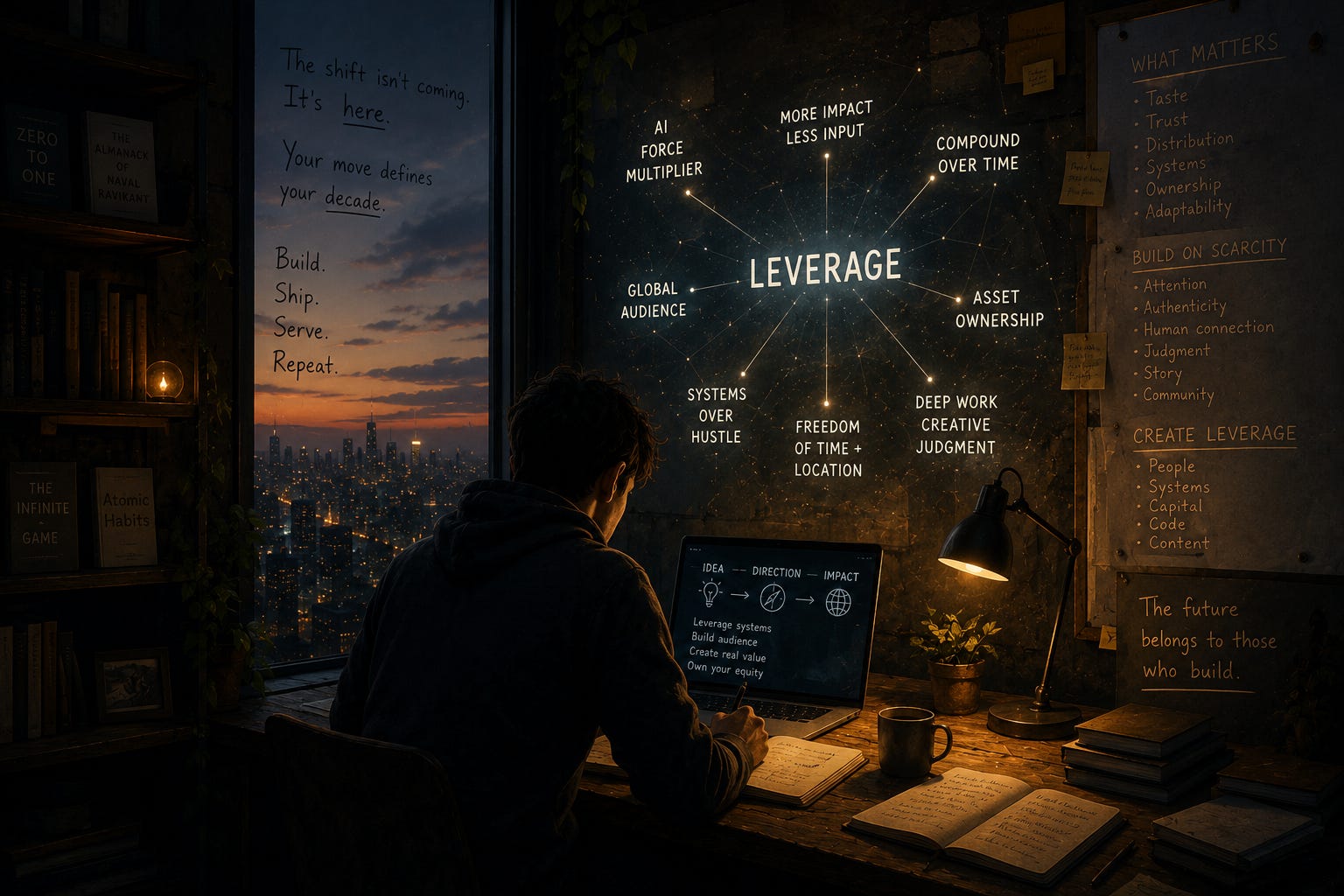
Put those pieces together and something strange falls out of the math. A single person can now do what used to take an organization. One human with a clear point of view, a trusted audience, and a stack of well-run AI systems can research like a team, produce like a studio, market like an agency, and ship like a startup. Alone. From anywhere.
You have probably already met one of these people without knowing it. The account that looks like a media company turns out to be one person and a laptop in a spare room. The newsletter that reads like it has a research desk has no staff at all. The studio is a single human who learned to conduct.
That word is the right one.
The next great fortunes will not be built by people who work harder. They will be built by people who coordinate better.
The most valuable person in the emerging economy is not the one who does the most work. It is the one who directs the most intelligence. Think of a conductor before an orchestra. The conductor plays no instrument and produces no single note, and yet the conductor is the only reason a hundred instruments become one piece of music instead of a hundred separate sounds. That is the role becoming precious: someone who can point humans and machines at a single outcome and knows what good looks like when it arrives. The skill of the future is not doing. It is directing.
How AI Changes Entrepreneurship Forever
For most of history, starting something meaningful required permission and capital. You needed money to hire the people who could execute your idea, and you needed someone with money to believe in you first. That barrier filtered out almost everyone.
It is collapsing. You can now build a product, test a market, find an audience, and earn revenue with tools that cost less than dinner. The capital you used to need to begin is no longer the wall. But here is the twist. When the cost to start falls to nothing, starting stops being the advantage. Everyone can start. The advantage moves to what you keep.
When anyone can begin, the winners are the ones who own what they build and let it compound.
Leverage is simply this: your output is no longer capped by your hours. The consultant trading time for money has none of it. The person who builds an audience, a system, a product, a body of work that keeps earning long after the effort is spent has all of it. So build assets you own, not tasks you rent out, and then give them time. A task ends the day you finish it. An owned thing grows on top of itself. The entrepreneur of the next decade is not the one with the best idea or the most funding. It is the one who understands compounding and is patient enough to let it run.
The Return of the Human
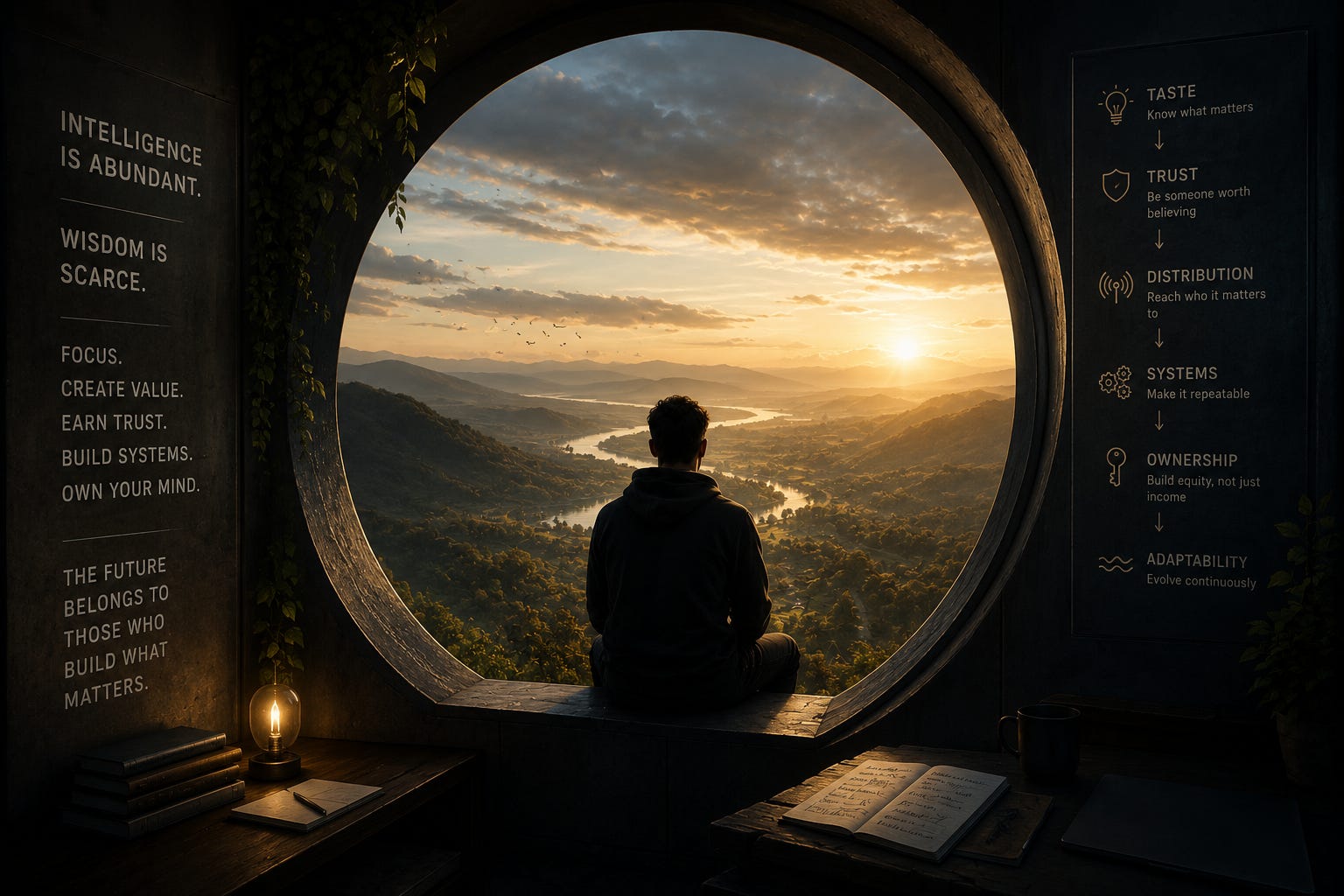
There is a beautiful paradox waiting at the center of all this. The more synthetic the world becomes, the more we will ache for what is unmistakably real.
As the internet fills with infinite generated everything, real human community becomes one of the most valuable things on earth. A room of actual people who know each other, trust each other, and choose to belong to something together cannot be faked by any model. People will pay for it, travel for it, and stay loyal to it in ways they never were to a feed.
So building community is not a marketing tactic. It is a long position on the one thing that cannot be printed. Audiences can be copied. Content can be cloned. A community that loves what it is part of cannot be reproduced by anyone, at any price.
The more the world fills with the synthetic, the more we will pay for the unmistakably real.
Even as you build systems and automate and scale, do not automate the human core. Be the real person behind the work. Show up for the people who show up for you. Let the machines carry the volume, and keep the human moments, the honesty and the care and the actual presence, for the things only a human can give. In an AI-saturated world that is not sentimentality. It is strategy. The human touch is becoming the premium product.
The Layer Beneath the Surface
Underneath all of this, something deeper is shifting that almost no one outside the technical world is watching, and it may matter most of all.
The internet is changing what it fundamentally is. For thirty years it was an information network. A place to publish, search, and read. A library anyone could write into. That era is closing. The internet is becoming an execution and coordination network, a place where intelligence does not just inform you but acts on your behalf, where software agents negotiate and transact and arrange things, where the unit of activity shifts from the page you read to the task that gets done.
This is a quieter revolution than the chatbots, and it is the foundation beneath them. Like every foundation, it runs on something physical and unglamorous. Intelligence at scale runs on compute, on energy, on data centers and chips, on the raw machinery that turns electricity into thought. The flashy part is the application. The durable part is the layer below it, the rails everything has to run on.
Everyone is staring at the applications. The fortunes and the power will accumulate one layer down, in the infrastructure no one is looking at.
There is a lesson in that even if you never touch a server. In any field AI reaches, ask what the new foundation is. Ask what everything depends on, what becomes more valuable as the volume on top of it grows. The defensible positions are not at the bright surface where everyone is crowding. They are at the foundational layer: the infrastructure of trust, distribution, coordination, and compute that the surface cannot live without. Own part of the foundation and you stop having to win the race on top of it. Everyone running the race pays a toll to you.
Adaptability Is the Only Permanent Advantage
One last principle, maybe the one that outlives every specific prediction here.
The AI era rewards adaptability and punishes rigidity at a speed we have never lived through. Skills that took a decade to master can be commoditized in a quarter. A strategy that printed money last year can be dead by the next. The half-life of any single advantage is shrinking toward nothing.
So the meta-skill, the ability to learn and unlearn and learn again, is worth more than any one competency you could name. The people who suffer most will be the ones who fused their identity to a fixed way of working and could not let go when the ground moved. The ones who thrive will hold their methods loosely and their principles tightly, and watch their old advantages dissolve without panic, because they trust themselves to build new ones.
The future does not belong to the most skilled. It belongs to the most adaptable.
Do not fall in love with how you work today. Fall in love with the deeper game. Taste. Trust. Owned distribution. Systems that compound. Intelligence pointed somewhere worthwhile, with a human standing at the center of it. The tactics will turn over every year. Those principles will hold for the entire era.
A Historic Window Is Opening
Step back far enough and you can feel how rare this moment is.
Every few generations the world hits a hinge. The cost of something fundamental collapses, and for a short window the old advantages stop working and the new map has not been drawn. The printing press did it to information. Electricity did it to production. The internet did it to distribution. In each of those windows, a small number of people who saw early what was happening walked away with reach and power their parents could not have imagined.
We are inside one of those windows right now.
And every great transfer of wealth in history happened the same quiet way. The unit of value changed, and most people kept holding the old one, because the old one was all they had ever known. The output is inflating. The things that cannot be printed, the taste and the trust and the real human bonds and the foundation underneath, are about to be worth nearly everything. You are early enough to move what you hold while moving still costs almost nothing. Most people will not. They will work harder at producing the very thing the world is drowning in, and they will wonder why the effort stopped paying.
For the first time in history, one person can hold the leverage of an institution. A clear point of view and a few well-built systems can reach millions and shape a corner of the world from a kitchen table. That used to take an army. Now it takes understanding, patience, and the nerve to position yourself for the world that is arriving instead of the one that is leaving.
The era will not ask whether you can use AI. Soon that will be like asking whether you can use electricity. It will ask the harder and more human questions. What did you choose to point all that intelligence at. Who trusted you enough to follow where you pointed it. Did you have the nerve to plant yourself in the right ground while the ground was still soft.
The window is open. It will not stay open. Stop watching the smoke. Look hard at the fire underneath, and walk toward it, while the rest of the world is still busy being amazed by the smoke.
Great post Kyle 👍
I think you’re right. Just be mindful that even “taste” itself will become harder to compete on. AI agents are getting better harnesses and workflows, and being systematic in the way they collect feedback and test their hypothesis.
A visionary will still occasionally outperform the system, but over time, strong and repeatable processes may become the main source of scalable “good taste”, especially as AGI capabilities appear.
That said, "taste" may end up being intimately human, like in "Her", and you nailed it well:
trust, branding, community, and network effects.
The other thing I’d add is this:
- Problems are infinite.
- Reality and physics still impose constraints.
- AGI doesn’t automatically cure cancer or invent near-light-speed engines.
- We still need experimentation, trade-offs, and human ownership.
And many of those trade-offs are not purely rational / probabilistic. They’re ethical, political, emotional, or motivational.
That’s why humans will remain central in areas where trust, persuasion, leadership, creativity, and social coordination matter. Politics, entrepreneurship, acting, sales, community-building, etc. will likely be heavily augmented, not replaced.
Some roles will disappear. Some will shrink (like customer chat support). Entirely new categories will emerge (like AI Engineer has), while everyone else just gets significantly augmented.
Because in the end, productivity doesn’t eliminate demand, it's insatiable. As we solve problems faster, humans create new ambitions, industries, and new problems worth solving (that weren't possible before).
We won't end up in a jobless economy, we will just end up with a much bigger economy.
Anyway, my 2 cents. Thanks once again Kyle and keep up with the good writing 💪